
A house flip contingency budget is the line that keeps one bad surprise from turning a profitable deal into a break-even one. The question is never whether to carry one. It is how much.
Investor guidance puts the baseline at 10% to 15% of the rehab budget (BiggerPockets, The Costs of Flipping a House, 2026). Experienced flippers go as high as 20% on larger or less certain projects. Fix-and-flip lenders describe a similar range, and several point toward the higher end as 2026 material costs rise (Stormfield Capital, 2026). That range is a starting point, not a rule. The right number depends on your specific property.
Key Takeaways
- The common baseline is 10% to 15% of the rehab budget, with many 2026 guides favoring the higher end.
- Older homes with original systems justify a higher contingency, often 15% to 20%.
- Contingency is not the same as a padded line-item estimate. It is a separate reserve for what the estimate cannot predict.
- Size it against your specific property’s age, systems, and scope, not a flat industry number.
- Track what you draw from it in real time, so you know whether you are on pace or already over.
Why a flat percentage is not enough
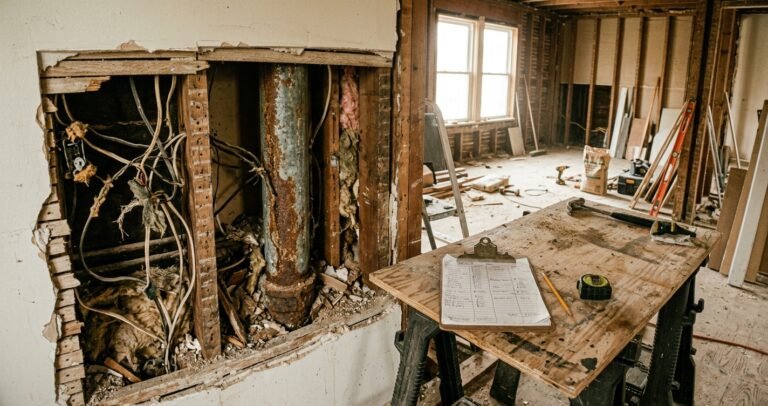
A 10% contingency on a light cosmetic refresh of a 2005-built home covers a very different risk profile than 10% on a full gut of a 1950s house. That older home likely has original wiring and cast iron plumbing. Using one number for both means overpaying for contingency on the easy deal and underfunding it on the hard one.
The line items that actually draw down a contingency fund are predictable in category, even if they are not predictable in dollar amount. Hidden electrical and plumbing, structural surprises behind finished walls, and code-triggered upgrades a permit forces on you mid-project are the usual drivers. See why house flip budgets blow up for the full list of what drives these draws. See house flip profit tracking, stage by stage for how contingency fits into your overall profit picture.
How to size your contingency
Start at 10% to 15% for a standard rehab. If the home was built after 1990, has an updated panel, and the scope is mostly cosmetic and mechanical maintenance, the industry baseline is a reasonable starting point.
Move to 15% to 20% for older homes with original systems. A property built before 1970 with visible knob-and-tube wiring, galvanized plumbing, or no record of a panel upgrade carries meaningfully more risk. That higher range is a common practice among experienced flippers, including the roughly 80 flips behind this guide.
Adjust for scope, not just age. A full gut carries more unknowns than a room-by-room refresh, even on a similarly aged property, because more of the structure gets opened up. A light rehab on an older home can sometimes sit lower than the age-based range if the systems were already updated by a prior owner.
Confirm with a systems-focused walkthrough before you close. A few minutes with a licensed electrician or plumber during due diligence tells you more about real contingency risk than the home’s age alone.
Contingency is not the same as padding your estimate
A common mistake is inflating each line item by 10% instead of carrying a separate contingency reserve. That approach hides risk rather than pricing it. It also makes it harder to see whether you are actually on budget, because every category looks artificially safe until it is not.
Keep your rehab estimate honest, category by category, and keep contingency as its own separate line. When a surprise hits, you draw from the contingency line specifically, and you can see exactly how much of your buffer remains. That distinction is also what keeps budget versus actual on a house flip meaningful instead of misleading.
Track what you draw, not just what you set aside
Setting the number at underwriting is the easy part. The harder discipline is tracking draws against it as the rehab happens. That is what tells you in week three whether you are pacing fine or already burning through the buffer meant to last the whole project.
Log every contingency draw the day it happens, tied to the specific line item that triggered it. If you are past halfway on contingency before you are past halfway on the rehab timeline, that is a signal to re-scope, not a number to ignore until closing.
Frequently asked questions
What percentage should I budget for contingency on a house flip?
Plan on 10% to 15% of the rehab budget for a standard project, and lean toward the top of that range as material costs rise. Push higher, into the 15% to 20% band, for a property with original electrical or plumbing systems still in place.
Is contingency the same as a padded estimate?
No. A padded estimate inflates individual line items to build in a hidden buffer, which hides real cost per category. Contingency is a separate reserve you draw from explicitly when a specific surprise appears, which keeps your line-item budget accurate.
Does contingency size depend on the property or the rehab scope?
Both. Property age and system condition set the baseline risk, and rehab scope adjusts it. A full gut on an older home needs a higher contingency than a light cosmetic refresh on the same property, because more of the structure gets exposed.
What happens if I use up my contingency early?
Treat it as a scope signal, not just a budget number. Burning through contingency well before the rehab is on pace usually means the original scope missed something. Re-evaluate the project before you commit more spend.
Set the number, then track against it
A house flip contingency budget starts with a 10% to 15% baseline and moves higher for older homes with original systems and larger scopes. Keep it separate from your line-item estimate, and size it to the specific property in front of you. Track every draw as it happens instead of discovering the shortfall at closing.
See why house flip budgets blow up for the specific line items that most often draw down a contingency fund. Keep budget versus actual on a house flip accurate as those draws happen.
This article is for education, not financial or investment advice. Portions were drafted with AI assistance and reviewed by the author.
About the author — Albert Chui. Albert Chui is a real estate investor in the San Gabriel Valley, California, who has flipped roughly 80 houses in the area since 2021. He ran those projects on spreadsheets at first, and learned firsthand how contractor changes, delays, and mid-rehab overruns quietly turn a profitable deal into a thin one. He founded FlipMargin so flippers can see current costs and projected profit throughout a rehab, not just at closing.