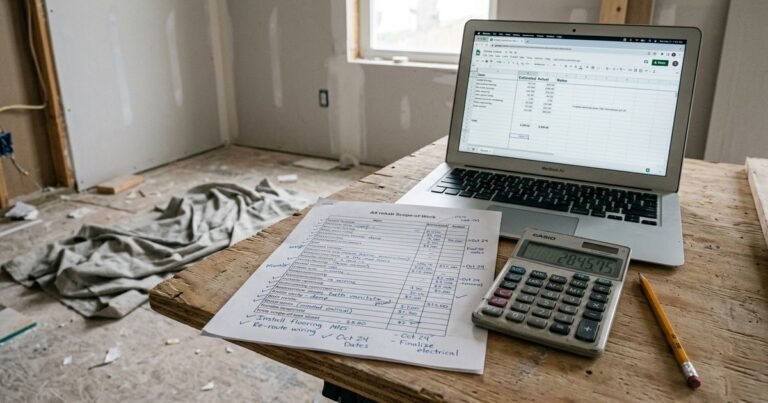

House flip holding costs are what you pay just to own a property while it sits mid-rehab, before it sells. They are the quietest line in the profit formula, because they accrue whether or not any work happens that week.
House flip holding costs include loan interest, property taxes, insurance, utilities, and upkeep for every month you hold the property. On a typical financed deal they run somewhere around $2,000 to $2,500 a month. This guide breaks down each piece, runs a monthly estimate, and shows how a slow rehab turns holding costs into a margin problem.
Key Takeaways
- Holding costs are the cost of owning the property mid-project: interest, taxes, insurance, utilities, and upkeep.
- On a financed flip, loan interest is usually the largest piece, often 70% or more of the monthly total.
- Estimate them as a monthly figure, then multiply by a realistic timeline, not your best-case one.
- ATTOM’s Q1 2026 data puts the median flip at 165 days from purchase to resale, so plan for five to six months of carry.
- Every week the rehab slips adds a full week of holding cost straight to the cost side of the deal.
What house flip holding costs include
Holding costs, also called carrying costs, are every recurring expense tied to owning the property between purchase and sale. Five buckets cover almost all of it.
Loan interest
If you financed the purchase or rehab, interest accrues every month you hold the loan. On short-term flip financing this is the biggest holding cost by far. Private-lending rate summaries put 2026 fix-and-flip hard money loans around 10% on average, with most deals priced between 9% and 11% (Pimlico Group lending data, 2026). A $200,000 loan at 10.5% costs about $1,750 a month in interest alone. Cash buyers skip this line but still carry an opportunity cost on the money tied up.
Property taxes
The county bills property tax whether the house is occupied or gutted. Divide the annual tax by 12 for a monthly figure. Rates vary widely by state, from under 0.5% to over 2% of value. On a $250,000 property at a 1.2% effective rate, that is roughly $250 a month.
Insurance
A standard homeowner policy does not cover a vacant property under renovation. You need a vacant-property or builder’s risk policy, which is priced on project value and term. On a mid-priced flip that usually works out to roughly $100 to $200 a month. Get a real quote before you close, since the range across carriers is wide.
Utilities
Power and water stay on through the rehab for tools, lighting, and testing. Expect $80 to $150 a month combined, more in extreme weather when you are running heat or air to protect finishes.
Upkeep and other
Lawn care, snow removal, security or a monitored alarm, and HOA dues if the property has them. Small individually, but $50 to $150 a month together, and a code-violation fine for an unmowed lawn costs far more.
A monthly holding cost estimate
Here is a realistic monthly total for a financed flip. The deal: a $250,000 purchase with a $200,000 hard money loan, in a market where effective property tax runs near 1.2%. Figures are illustrative.
- Loan interest ($200,000 at 10.5%): $1,750
- Property taxes (1.2% of $250,000, monthly): $250
- Vacant-property insurance: $150
- Utilities: $120
- Lawn, security, and other: $80
- Monthly holding cost: about $2,350
At $2,350 a month, a five-month project carries about $11,750. A six-month project carries $14,100. That $2,350 difference comes off your net profit for nothing but time. For where holding costs sit in the full calculation, see how to calculate house flip profit.
How the timeline multiplies the cost
Holding cost is a monthly rate, so your total depends entirely on how long you hold. That makes the rehab timeline a financial number, not just a scheduling one.
ATTOM’s Q1 2026 U.S. Home Flipping Report put the median time from purchase to resale at 165 days, roughly five and a half months (ATTOM, June 2026). That is the median, so half of all flips take longer. If you underwrite a deal assuming a three-month hold and it runs six, you have doubled the holding cost line.
Three habits keep this under control:
- Estimate off a realistic timeline. Use your actual average days-to-sell for the market, not the fastest project you ever did.
- Add holding cost to every delay conversation. When a permit slips two weeks, the cost of that slip is two weeks of carry, and it should be said out loud.
- Track days held as a live number. Watching the holding-cost clock alongside your budget keeps the timeline honest. See house flip profit tracking, stage by stage.
Points, fees, and the cost of an extension
Loan interest is the recurring piece, but flip financing carries one-time charges that belong in the same mental bucket, because they scale with how the loan is structured.
Origination points. Most hard money lenders charge 1.5 to 3 points up front, where one point is 1% of the loan amount (lender pricing data, 2026). On a $200,000 loan, two points is $4,000 paid at closing.
Extension fees. If the rehab runs past your loan term, the lender charges to extend, often another point or a step-up in rate. A six-month loan that needs a two-month extension can add $2,000 to $4,000, on top of the extra carry you were already paying.
Draw fees and inspections. Rehab loans release funds in stages, and some lenders charge a fee or an inspection cost per draw. Small per event, but they add up across a full renovation.
The takeaway: a longer hold does not just add monthly interest. It can trip an extension fee and stack points on points. Build a realistic term into the loan from the start.
Frequently asked questions
How much are holding costs on a house flip?
On a financed flip, plan for roughly $2,000 to $2,500 a month, with loan interest the largest share. The exact figure depends on your loan balance and rate, local property tax, and insurance. Cash deals are lower but still carry taxes, insurance, and utilities.
Are holding costs the same as closing costs?
No. Closing costs are one-time fees paid at purchase and at sale. Holding costs are recurring monthly expenses for the time in between. Both belong in the profit formula as separate lines.
Do holding costs count if I pay all cash?
Yes, minus the loan interest. You still owe property taxes, insurance, utilities, and upkeep every month. You also carry an opportunity cost on the cash, since it cannot be working on another deal while it sits in this one.
How do I lower holding costs on a flip?
Shorten the timeline. A tighter scope of work, materials ordered before demo, and a contractor who can actually start on your date all reduce months held. On the financing side, compare lender rates and avoid extension fees by building a realistic term into the loan.
Plan for the carry, then beat it
Holding costs are small each month and large by the end. Estimate them as a monthly figure, multiply by a timeline you would actually bet on, and treat every rehab delay as the dollar cost it is. Then work the schedule to bring the number down.
Next, plug your monthly carry into the full deal math in how to calculate house flip profit, and pressure-test it against a target return using the 70% rule.
This article is for education, not financial or investment advice. Portions were drafted with AI assistance and reviewed by the author.
About the author — Albert Chui. Albert Chui is a real estate investor in the San Gabriel Valley, California, who has flipped roughly 80 houses in the area since 2021. He ran those projects on spreadsheets at first, and learned firsthand how contractor changes, delays, and mid-rehab overruns quietly turn a profitable deal into a thin one. He founded FlipMargin so flippers can see current costs and projected profit throughout a rehab, not just at closing.